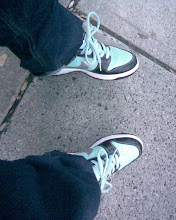
Join me, if you would, in the contemplation of a thoroughly busying and yet entirely refreshing week(end).
Wednesday11.11.2009
Ms. Lee Philosophises.
Saturday11.14.2009
My parents arrived in town at high noon; realizing that
they had never visited the Yale University Art Gallery,
I gave them a short tour while we waited for the homey
Capt. Joel Lee to arrive in from UMass.
小狗!
Wave 11; it's always amazing to me to see strength and motion
captured in a static medium. This piece embodies so much of what I
consider to be aesthetically pleasing.


三个小孩儿

Reminds me of an enemy from Chrono Trigger.
Sunday11.12.2009
After a sleepless night of sermon preparation and a long day of
fellowship at church, some of the UCW men and I went out to
celebrate Garrett's 21st by eating sushi until we couldn't talk.
Before starting to eat (you do not want to see after).
The ice cream goes down so smooth, it's not as though
it even occupies alimentary space.

In the words of the waitress, upon our fourth round of ice cream,
"So, basically... you want a whole bunch of ice cream."
Go to Sushi Palace on a Friday, Saturday, or Sunday; on these three
days, they have in-house green tea ice cream that is super fly.
Digging in.
Sunday, November 15, 2009
YUAG/G-Fid's 21


Wednesday, August 12, 2009
Personal reflections on Chinese America
A request from a friend taking a summer Ethnic Studies course at school served as the excuse to finally get some thoughts down that I've been hoping to commit to paper ("paper") for a while, now.
Thoughts are scattered, quite randomly arranged, and topics range wildly about. Many thoughts are unsupported, at best, and citations are nonexistent. This is more to have this on record and for those who care to get a stronger sense of my background and current stance on certain issues.
Reading over my thoughts - or, properly speaking, even as I typed them out in more or less stream-of-consciousness flow - I worry that I am myopic. My image of Asian America is gilded and almost universally positive: at least, my first responses to Chinese-American culture is always to assume that the minority has been victimized, is guilt-free, and has taken at most a passive part in the lead-up to the current state of affairs. I acknowledge freely, I think, that Chinese immigrants have been complicit in their own sufferings: but I do not first jump to the domestic abuse epidemic rampant in our communities (and countries of origin).
I tend to lionize the underprivileged and vilify the dominant. This is not wrong, but it is not right: worst of all, it is not true. The causes of current circumstances are manifold, and to simplify it down to Western imperialism (cultural, political, economic, and military) is to discredit my own claims. I worry about this, in the long run: I will have to become far more balanced and willing to critique China, Chinese America, and the Asian milieu if I am to be a credible and caring commentator.
I also have large holes in my discussions of gender. I make assumptions about female roles, rights, responsibilities, and representations (3 cheers for that alliterative streak) that are founded entirely on my male understanding of the female experience and role in society. This is dangerous, and I apologize if I wrongly offend. It's on my list of things to work on.
That said, the text of my response is presented below (cleaned up & edited in brief, most portions of the original text/questions remain):
1. experiences:
a. family traditions/customs/holidays
b. experiencing racism
c. basically, how was it like growing up chinese american?
(attempting to answer the breadth of a-c in one long breath:)
Basically, when I was young, being Chinese-American (which is, I might note, a different term than "American Chinese" or "American of Chinese descent") wasn't something that I thought about at all. There are a few factors that contributed to this: my parents were second- (or greater) generation, already, being born in Southeast Asia to families that had previously immigrated from China, so I was at least two degrees separated, on both sides, from direct ties to Chinese culture and heritage. I knew, on a fairly abstract level, that there was something tying my past to "China" - but that word, "China", referenced an empty concept, for me. Apart from Geography Bee-level details - the Yellow River, the Yangtze, Shanghai, Beijing, Hong Kong, etc. - I had no knowledge of China, and definitely no personal connection. The only glimpses of Chinese Culture that I received were in our shamefully irregular visits to my Nai nai/奶奶 (father's mother), who lives outside Washington, DC with her second husband (now deceased). There, I got my most transparent hints of the rich culture underlying our family's roots: conversations carried out in incomprehensible tongues; homecooked Chinese food utterly unlike my mother's Western cooking or greasy "Chinese" takeout; red envelopes of New Year money (that were, I realized much later, not months late, but simply operating according to a different calendar), watercolors of tumbling Chinese mountains, etc.
In short: our family traditions, customs, and holidays were as utterly middle-class, suburban American as one can get: dressing up for Easter Sunday, stockings on the mantle & gifts under the Christmas tree, ice cream cakes at birthday parties.
Which is why, I think, for me, racism was always a little bit of a surprise. After all, the far greater part of my upbringing was indistinguishable from your average American Dream: in the middle of the upper-middle-class, attending a Protestant church and Sunday School every weekend, straight-A report card, etc. But a few incidents stick out, in particular:
- While growing ever-more-increasingly Westernized, my parents, throughout my youth, continued to frequent the local Asian Groceries (albeit more and more infrequently). One of the snacks they would occasionally purchase there - and which I found not so much tasty as intriguing - was made of this sort of cheeto-like material; except, instead of being coated in "cheese" and "cheese" flavoring, it tasted like shrimp. One time, during a kindergarden lunch, I made the mistake of bringing - or my mom made the mistake of packing, in the best of intentions? - a bag of them to school. The White girl with whom I usually traded sandwiches and snack foods turned up her nose at them, declaring them - I'm paraphrasing - "smelly" or "yucky". I must have been 5 or 6; that was, I believe, the first time I had ever been told that something which I considered normal - banal, even - might be Different.
- Towards the end of my attendance of that Christian school (I realize, only at this moment, that the reason my parents probably entrusted me to them was that both my mother and father grew up going to Christian schools in Southeast Asia; and they were likely sending me to this school in hopes of my attaining the same education with which they had been bestowed), I recall that I came home one day and casually, after dinner, reading some book about geography or cultures or something of that nature, pulled my already asiatic eyes up into an exaggerated slant, telling my mom: "look. Chinese!" I can still remember her horrified response, the shock with which she realized that this so-called Christian education (I don't blame the church, of course; I do blame the ignorance and idiocy of young children, coupled with the race-blind/PC-disavowing/
culturally underinformed nature of many well-intentioned evangelical communities) was actually driving a wedge between her son and her own background (I recently discovered that she had actually been planning, prior to the time she became pregnant with me, to go into law to help out asian-american and immigration issues). Shortly thereafter, for a host of reasons, my parents pulled me out of that school.
- Something that's often echoed by various generations and varieties of Asian-Americans is the sentiment of being a "perpetual foreigner": a Japanese-American senator, whose family has been in this country for over 80 years, once remarked that he still continually receives compliments for speaking English "so fluently". As a youth, I too had these jarring encounters: trivial at the time, I brushed them off casually, dismissing them as isolated incidents of ignorance or misinformation. Of course, the fact remains, at 23, and with a far broader range of experiences in the intervening years, I can still remember, vividly, the repeated confusion of being asked by young White children, "So, where are you from?" and the frustration of having to, repeatedly, explain that I was from Illinois - or California - or Delaware. I knew who I was, and where I was from; so why couldn't these other kids? A dilemma emerged: either they were simply stupid and couldn't see the blatantly obvious (which seemed unlikely, given that my American-ness seemed to me overt), or the premises on which I had established my identity, with my internal concept of The Normal American Childhood derived from my own experience, were faulty.
2 & 3. as a chinese american, how do you identify yourself? what does being "chinese american" mean to you
Given the circumstances of my upbringing, and my parents' immigration, I think it wouldn't come as much of a surprise to hear that my view of myself, in my younger years, was basically that line about "diversity" that we were fed back in the day: "We want to be color-blind." I bought into the construal of Ethnicity that said the best way to accept everyone was to "just look at people as people, not as their skin color." So I applied this happily homogenizing view to myself, and those around me, and assumed that our points of view, personal experiences, and inculcated values more or less lined up. The emphasis in those days was definitely more on "American" than on "Chinese".
In recent years, I've been coming to hold a more subtle approach towards regarding my ethnic heritage: without running out the clock (because I definitely could), the basic outline of my thoughts go as such:
- The term "Asian-American" is in itself dangerous, because it is an umbrella term for vastly disparate groups: in the same way that pitting inner-city Boston Irish youth with jailed parents against as Upper East Side, trust fund, private school kids is unfair in terms of social neediness, so is judging the children of Hmong, Vietnamese, Cambodian, and Filipino refugees against the kids of Chinese, Japanese, and South Korean businessmen, professors, etc. Not to mention that thinking that every Chinese immigrant is privileged, well-educated, and well-behaved - the "Model Minority" myth - is itself damaging in many ways to Chinese-American communities, for a whole variety of deep-seated reasons.
- For those of us who identify as "American of Chinese Heritage," there is a fine balance to be struck between that "American" and "...of Chinese Heritage". It's foolish to think that I am Chinese: in China, I might be allowed to call myself a "hua ren" (华人) that is, one of the Han Chinese, but I am not a "zhongguo ren" (中国人) that is, a Chinese person. Culturally, in terms of my fundamental assumptions about the world, I am a product of the West. It's important to point out that I don't harbor unnaturally Sinocentric political sympathies, and I'm not going to be a threat to peace in the American homeland or abroad (well, I oppose American hegemony - but that's for entirely different reasons): it's important to remind myself, and others, of this, because the reality is that many still fall into the mindset of Executive Order 9066 and "Yellow Peril", where any Asiatic face is viewed as a potential defector to the long-left-behind "Motherland." Of course returning to China - or heck, even Asia - gives me a warm feeling. But I have White friends who acquire the same sense of Homecoming upon their return to England, France, or Poland; and there is no forbidding sense of fraternizing with the enemy that lies upon their journeys.
- One interesting thing that I have realized is that "Asian America" exists: even as I decry the use of the term, the fact is, whether for right or wrong (I would say more wrong than right), we are seen as a monolithic group. But that makes certain connections possible in the American "melting pot" that otherwise may never occur: a Chinese person in China may never deign to bridge the gap and initiate a friendship with a Japanese individual. But my relationships with my Japanese and Japanese-American friends - heck, even your own parentage, right? - demonstrate that "Asian America" can serve as something of its own melting pot; even if we remain, perhaps, to the side of the rest of the "melting pot" (whether cultural, genetic, or otherwise), at least Asian America has served, it seems, to bridge divides that may not have happened in our mother countries.
4. how do you think "chinese american" is being represented? by AA? by the public? How accurate are these portrayals?
I think that the public image of Chinese-Americans is problematic, with the blame being distributed all around (though perhaps not equally): Chinese-Americans are at fault for playing into the role of a "Model Minority", passively or actively unwilling to speak out against a dominant and domineering culture, choosing to succeed by means of intellect or behind-the-scenes work instead of through protest and resistence (to generalize largely). Of course, Chinese immigrants' approach to a hostile culture is not to blame: given particular cultural values held by Chinese-Americans, this was the natural, moral, course. And the White media and government is at fault: anti-miscegenation laws, portrayals of the threat of "China Rising," anti-Japanese WWII propaganda (but no propaganda supporting our allies, no pro-Chinese or pro-Korean messages to counteract the inevitable conflation of our three sister cultures), E.O. 9066, all these were designed to Otherize and tokenize Asian peoples, to aggrandize the panic of American businessmen and laborers concerned with increasing competition from across the Pacific. The inherited reminders of these shackles - whether in popular culture or governmental representation - is still evident.
When talking about public, popular, media images of Chinese-Americans, three concepts spring to mind: Kung Fu Master, Exotic Asian Beauty, and Smart Chinaman.
- These portrayals are all highly damaging. Exoticism has been dealt with in a lot of gender/ethnic studies literature, but, in brief: to describe someone as "exotic" is to claim that they are attractive because they are not-me: they are the Other. Exotification is objectification and tokenization taken, in many ways, to its height: a person no longer represents a valued individual Self, but instead an alien, unrecognizable, unable-to-be-sympathized-with culture.
- Media obsession with Exotic Asian Beauties is particularly disturbing given that much contact between Americans and Asian women was in the form of soldiers interacting with wartime prostitutes during the Korean and Vietnam wars. The stereotypes of the Shy Asian Girl and the Seductive Asian Woman (the "Dragon Lady") conflate into a figure that is deserving of both moral scorn and sexual depredation. This is, of course, a faulty stereotype: it is an incredibly transparent attempt to remove en masse the femininity and womanhood of Asian females, in the same way that Black women were degraded by simultaneously being sexualized and defeminized by becoming the unacknowledged mistresses of slave-owners.
- Of course, one subtype of the Exotic Asian Beauty, that deserves particular mention, is the Madame Butterfly: caught up in the wiles and victimized by her brutal countrymen, this woman must be saved by the noble White hero. This stereotype is particularly notable because it implies that the Asians can't be trusted with taking care of their own: whether the next generation, the land, the businesses, the government, or the military, the natives need to be rescued by the strong white Savior. While it's true that Asian - and, yes, particularly Chinese culture - has been incredibly behind in terms of gender parity, and while I am by no means an anti-miscegenist, I do worry about the more or less pervasive idea that an Asian woman's dream is to escape the bonds of her culture and fly away to Western civilization and, apparently, cultural enlightenment.
- The Kung Fu Master is, in its own way, a dangerous stereotype. On one hand, it is fairly empowering and masculinizing. The downside of it is that any Chinese-American who shows strength will be associated with the Kung Fu Master. A strong Black man is not automatically compared to Mohammad Ali: but strong Chinese (or even broadly Asian) men will almost inevitably be compared to Bruce Lee. Again, this stereotype - while not necessarily negative - strips the target of his or her individuality, and places them within a narrowly defined role with little room for expansion beyond.
- And the Smart Chinaman is the very type of the Model Minority myth: the backhanded insult, the barbed compliment. It can be simultaneously dismissive of individual accomplishment - "Of course you did well on the math test, you asian" - and concealment for more subtle racism - "OK, so maybe Chinese-Americans have some problems, but you guys are doing so well! Look at your college acceptance rates! How can you complain about a couple of movie roles and some jokes on the radio and TV?"
Wednesday, February 25, 2009
对我妹妹很骄傲
I'm proud of my sister... she recently turned 20, but that's not the real salient point here... To commemorate her 20th year on top the earth she wrote a post summing up some thoughts & transformations that been going on in her mind-grapes:
"What Not Dating For 20 Years Has Taught Me About God
"It's an interesting feeling to be twenty and to have never dated anyone, and on purpose at that, LOL. God has made it amazing, and powerful, and wonderful. It's only scary when I'm not trusting God, which is always a powerful reminder to do so - one that I really need. I've felt God give me purpose and fulfillment and love and joy and peace, and been able to know that it's all from Him. So really, the title of this note should start off with "What God Has Taught Me." It's mostly interesting because I know that so far I've made the right choices as far as God's plan for me, and it's helped me personally honor God and grow in my relationship with Him.
"I just kind of wanted to reflect on what God's done after two decades. Cuz that's kind of a long time...."
(full public post here)
Sunday, February 22, 2009
Living Water Retreat
Saturday01.31.2008
On the night of the 30th, Living Water took a jaunt
down to Yonkers for Winter Retreat.
The place at which we stayed was a local house-style
church attended by several Yale alumni, including not a
few Living Water alums. Being a house church, our
accommodations were a local estate purchased by the
congregation, wonderfully appointed.

I loved this joint - drawers be madd personable.

This clock look straight out of H.G. Wells.


After kicking it with Living Water for a little longer than
half a day, my parents came through the neighborhood
(located thanks to their Christmas-present GPS unit) and
gathered me up, heading back up to New Haven to drop
off some items and hang out for a while.

Yowch... I think I was doing pull-ups at Justin's place
and this was one of the results.
Despite an increasingly-sure impeding cold, I was still most definitely
up to roll with my parents out to eat. We grabbed one of my
freshmen and rolled out to a place by which I had passed for years
without ever stopping in. Still, with my constant Chinese food jump-
off closed down (R.I.P. East Melange Express), I was in search of a
new joint - so we dropped by Hunan Cafe.

Yo the mid-level Chinese place down the street from our house back
in Delaware always had these crispy fried joints w/ orange sauce
waiting from the get-go. We hadn't even ordered and already Hunan
Cafe was up a point.

四川 dumpling - aiight for real.

父亲.

母亲.

学生.
Later that night.

Yoonjoo painted this.

SXR tag - Near Lynwood/Edgewood neighborhoods, New Haven.
Monday, January 19, 2009
Baltimore / Sneaker Hunting with 奶奶!
[The final issue in a series of eight, looking back on the
happenings and travels of my Christmas holidays spent
in New York, Delaware, Virginia, Maryland, and
Washington, DC.]
Saturday01.03.2008
Ray had returned to DC the previous evening to spend
the night at my grandmother's place with Lydia and me.
The next day, after picking up Soyoon from her cousin's
house, we headed back to Ray's home town of
Baltimore for a (well-researched on his part) day of
eating, browsing, and cultural cultivation.

First stop: Ray's friend's dad's Korean restaurant.

Appetizers... Yo I haven't had Korean appetizers (小吃?)
since the summer. The yellow pickled radish (Danmuji/
단무지) is my favorite, which I would consume in large
quantities along with rice, to supplement my meals in
Ilsan.


Deep-fried beef - awwww man. We finished off this
whole plate in addition to our own individual entrees.

Lydia's Korean omelet.

My Tchamppong (짬뽕), spicy Chinese-style (word?) seafood soup.

Afterwards, we headed downtown to walk off our lunch, perusing the
collections at the Walters Art Museum.

Even in the old days Koreans used metal chopsticks... Huh.

Scrimshaw rat, this joint was seriously lifelike (if not
life-size).


While Lydia finished up her tour of the museum, Ray,
Soyoon, and I headed outside to walk around in the
brisk winter air.


The country's very first monument constructed to
honor Washington.


? tag, park bench, Mount Vernon, Baltimore.
After we finished up at the art museum, we headed a
few miles farther out of the city center, to Baltimore's
Book Thing, a literacy project in one of the many
underprivileged areas of Baltimore.
At Book Thing, donors come by to drop off old, excess,
and used literary materials; they then reside in a
warehouse-style building, sorted by volunteers into
various categories, awaiting and inviting clientele to
come pick through their stacks.
I found a few items to take away - including a Chinese
text published by 北京大学出版社 - but my find of the
day was a paperback copy of Thomas Merton's Life and
Holiness.
Finishing up at Book Thing as dusk settled over the city,
we drove back to Baltimore's famed Inner Harbor,
parking Ray's car on the border of the Inner Harbor and
Little Italy. Still full from our expansive Korean lunch,
we decided to wander around the waterfront before
finally hitting Little Italy.

The National Aquarium's glass wall, which encloses a
microcosm of an entire tropical setting, including
3-story waterfall.

Outside the Baltimore Maritime Museum, several historic vessels
bob and sway at anchor, including this submarine.

As the sun set, we slowly wandered through the
nearby waterfront shops; then, after a pasta dinner
in Little Italy and pastries from the near and well-
reputed Vaccaro's bakery, we headed back down
in the direction of DC, where Ray dropped Soyoon
off back at her cousin's, then Lydia and I back at my
grandmother's.
On the final day of our stay in Bethesda, my grandma
asked me if there was anything left that I would like to
do or see before heading home. Having a generally
satisfying time between scanning the Mall and
Smithsonian on foot, running errands and cooking with
her, and our day in Baltimore, I could think of only one
last wish.
For nearly as long as I can remember being interested
in streetwear and fly hip-hop clothings, Commonwealth
has been one of the names that I always was checking
for online. With several store exclusives, a clean online
shopping interface, and consistent stocking lists of the
flyest status and names in the game, they are one of the
stores that give boutique shopping its name.
However, not spending much time recently in the DC
metro area left me with few-to-no opportunities to drop
by the store and check out their brick-and-mortar
operations for myself. But, with a morning and
afternoon to kill before my dad could arrive back in the
area from Delaware, grandma decided to roll with me
and Lydia, and we headed out, GPS in hand, to try and
find our way over to Florida Avenue.

The brand-new GPS (my Christmas gift to my parents,
promptly lent for my stay in DC) got us there without
any issues (my grandmother: 这样的机器很好用的!).

The store.

Down the street, right next to Stussy DC, lies Commonwealth's second
retail location, For the Greater Good. Carrying a lineup of slightly more
mature streetwear brands (APC, Clae, Creative Recreation, etc.), the
store brings more dimension to the area's mercantile lineup.

KAWS mats and t-shirts in Commonwealth.

DC's Florida Ave., 1700 block: Stussy DC, For the Greater Good, and
Commonwelath.

We returned to my grandmother's apartment in the mid-
afternoon, and my dad arrived shortly thereafter,
bearing gifts and more burdens for grandma...
My parents, as a graduation present, had purchased a
BAPE cardigan for me, imported from Japan. Sadly, a
Medium cut turned out to be somewhat larger than we
had expected and, after my slimming summer in Korea,
it no longer fit. Thankfully, Grandma had been
vocationally and for a long term employed as a
seamstress in the old country, before and even during
the first portion of her current life in America.
Despite having not done alteration or full-out tailoring
work for several years, Grandma still keeps her sword
sharp, with no fewer than three sewing machines still
in working order in her bedroom workspace. After
taking a few measurements, she set to work on taking
in the cardigan.


After eating a dinner of leftovers (and what leftovers
were had from the last week!), we bid farewell to 奶奶
and headed back up to Delaware, to spend the night
at home and then spend the following day on public
transportation, on our return trip to New Haven.
Oh, and our morning excursion into DC bore fruits
beyond the (immensely more important) spiritual
blessing of my grandmother sharing in my hobby,
pursuits, and interests.

Commonwealth was unloading a good chunk of
warehoused inventory at great prices - I almost copped
a pair of premium Barkley AF1 highs for $50 (less
than 30% of their original asking price of $175) - and
various other items, for reasons of recession and
holiday shopping season pricing, were being sold on the
cheap.
However, there was one pair of kicks that grabbed my eye upon my
first scanning the store.

A pair of Nike Air Footscape Wovens, marked down, and in my exact
size, to boot.
But not just any footscapes:

The CLOT/ACU "Rasta" Footscapes: originally limited to 24 pairs,
released in 2006 to celebrate the opening of CLOT's 上海 retail boutique
ACU, these joints were initially available only to Clot family & friends
(including Edison Chen, his girl, top designers, and friends like jeffstaple).

Later in 2006, these dropped - to great fanfare and scarcity - as a
quickstrike edition in the States, and promptly sold through whatever
size runs were available in stores. This pair was only preserved via
falling prey to the maze that is Commonwealth's stock warehouse,
and had sat in silence for nearly two years, until they were found and
pulled out into the store, awaiting a size 8 foot.

On ice, waiting for the summer summertime...
series fin.